
HPLC Practical Guide Complete Series
17 Practical PDF Parts for Beginners, QC Analysts, and New Laboratory Professionals
A step-by-step, practical guide to help you understand HPLC concepts, operate systems confidently, troubleshoot effectively, and apply best practices in real laboratory work.
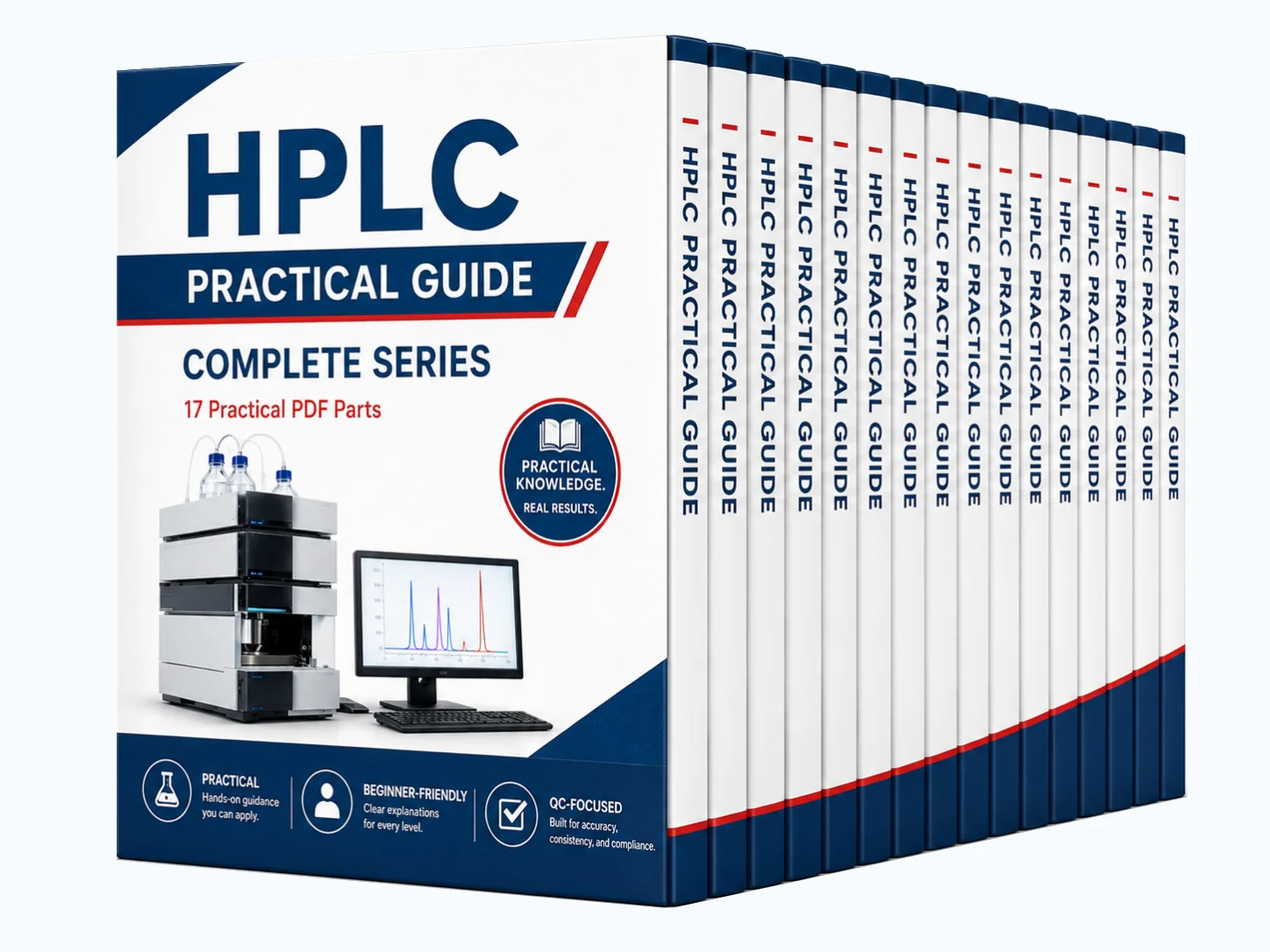
17 PDF Parts
Practical Diagrams
Beginner-Friendly
QC-Focused
Instant Download
Who Is This Series For?
• Beginners who are new to HPLC
• QC analysts and laboratory technicians
• Students and fresh graduates
• Professionals who want practical, hands-on guidance
• Anyone preparing for HPLC interviews or job roles
What You’ll Learn Across the Series?
• HPLC Fundamentals and Principles
• System Components and Instrumentation
• Mobile Phase Preparation and Solvent Handling
• Column Selection and Stationary Phase Basics
• Detector Basics and Chromatographic Signals
• Chromatogram Reading and Peak Integration
• System Suitability and QC Readiness
• Assay and Impurity Testing
• Method Development Basics
• Troubleshooting and Maintenance
• Career and Interview Readiness
• Practical HPLC Case Studies
Free Starter Kit
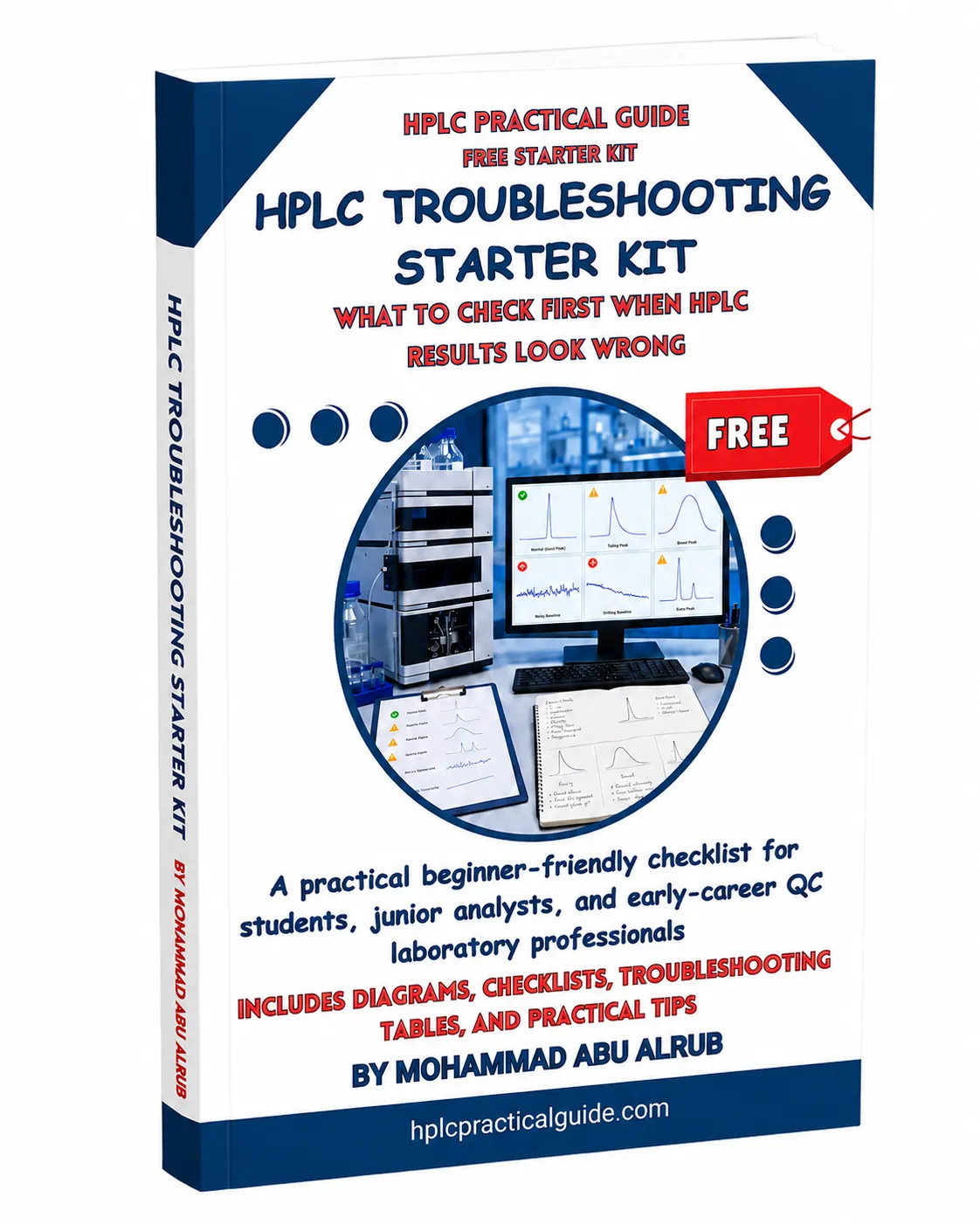
Get a free sample to explore the content and teaching style.
Watch the 17-Part Series Walkthrough
Explore how the complete HPLC Practical Guide series is organized and how each part builds practical HPLC confidence step by step.
Explore the 17-Part HPLC Practical Guide Series
Part 1
HPLC Fundamentals
Part 2
Mobile Phase & Solvents
Part 3
Pump and Flow Rate
Part 4
Injector & Autosampler
Part 5
Column & Stationary Phase
Part 6
UV & PDA Detection
Part 7
Peak Integration
Part 8
Separation Logic
Part 9
HPLC Run Workflow
Part 10
System Suitability
Part 11
Assay Determination
Part 12
Impurity Testing
Part 13
Method Development
Part 14
Peak Problems
Part 15
Baseline & Pressure
Part 16
Career Readiness
Part 17
HPLC Practice Cases
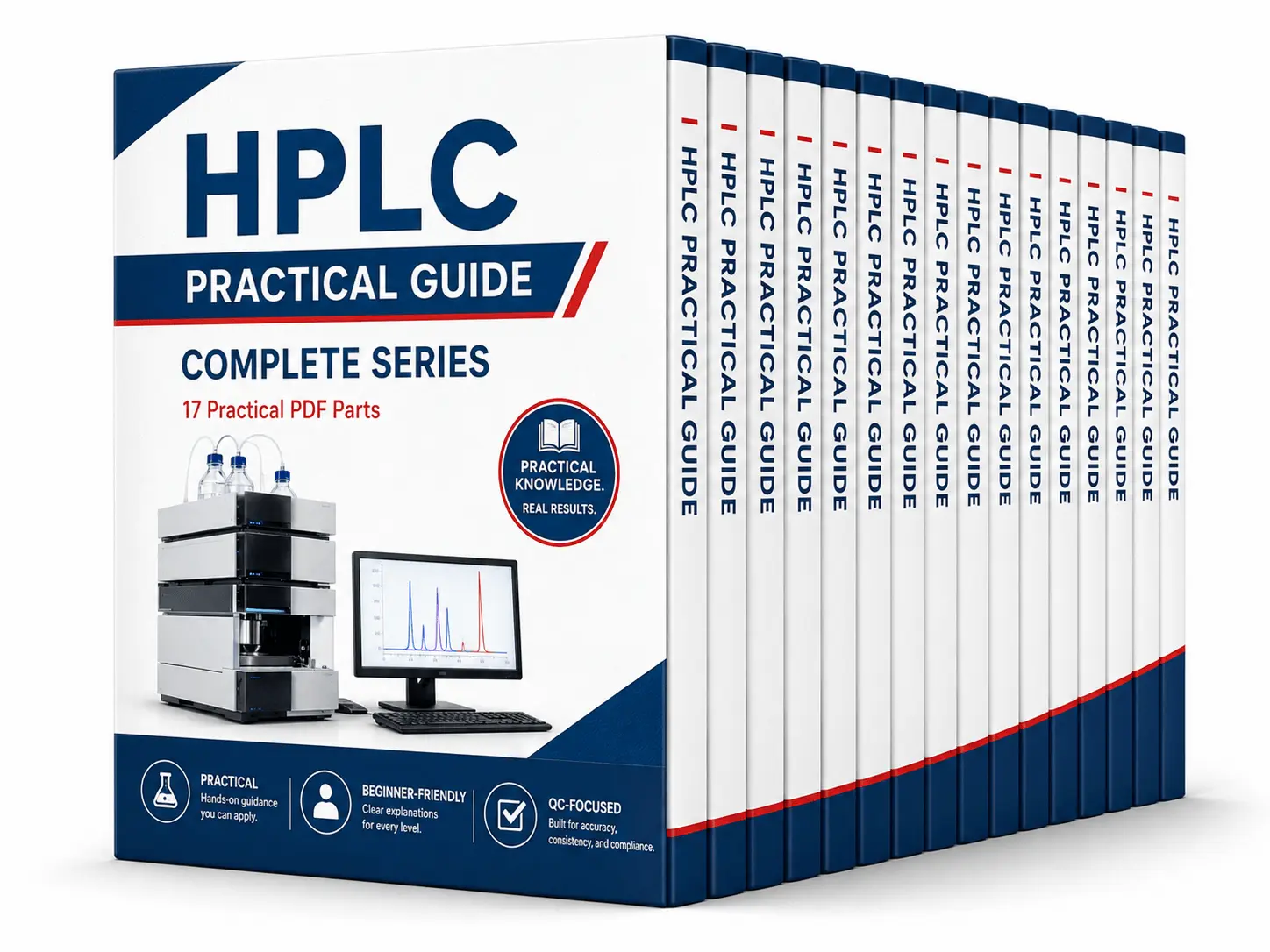
Get the Complete
17-Part Series
$49
One-time payment. Lifetime access.
Includes:
• 17 Practical PDF Parts
• Instant Download
• Lifetime Access
• Beginner-Friendly Explanations
• QC-Focused Practical Approach
• Step-by-Step Learning Structure
• Troubleshooting Tables and Practical Cases
• Study at Your Own Pace
Detailed Breakdown of the 17-Part Series
Explore what each PDF part covers before getting the complete series.
Part 1: HPLC Fundamentals Made Simple
A beginner-friendly introduction to the HPLC system, flow path, main components, chromatogram basics, and how HPLC fits into laboratory analysis.
Part 2: Mobile Phase Reservoirs and Solvents
This part explains how mobile phase reservoirs, solvents, filtration, degassing, buffers, and pH control affect chromatographic performance and result reliability.
Part 3: Pump and Flow Rate
This part helps beginners understand how the HPLC pump controls flow rate, pressure, stability, priming, purging, and common flow-related problems.
Part 4: Injector and Autosampler
This part explains how samples enter the HPLC system, including injection volume, autosampler function, carryover, vial condition, and injection reproducibility.
Part 5: Column and Stationary Phase
This part introduces the HPLC column as the heart of separation and explains stationary phase, column dimensions, particle size, guard columns, and column care.
Part 6: Detector Basics: UV and PDA Detection
This part explains how UV and PDA detectors convert analyte absorbance into chromatographic signals and how wavelength selection affects sensitivity and results.
Part 7: Chromatography Data System and Peak Integration
This part explains how chromatographic signals become reportable results through peak detection, integration, baseline placement, area calculation, and basic data review.
Part 8: Column Chemistry and Separation Logic
This part helps learners understand retention, selectivity, resolution, mobile phase strength, pH, column chemistry, and practical ways to improve separation.
Part 9: Starting, Running, and Shutting Down the HPLC System
This part guides beginners through practical HPLC workflow, including startup checks, purging, column equilibration, sequence setup, shutdown, and column storage.
Part 10: System Suitability in HPLC
This part explains how system suitability confirms that the HPLC system is ready for analysis using retention time, area %RSD, tailing, plates, and resolution.
Part 11: Assay Determination by HPLC
This part explains how assay results are calculated from standard and sample peak areas, dilution factors, concentration, response, and final percentage results.
Part 12: Related Substances and Impurity Testing by HPLC
This part introduces impurity testing, small peak interpretation, area percentage, known and unknown impurities, reporting limits, blank checks, and basic impurity evaluation.
Part 13: HPLC Method Development Basics
This part explains the beginner logic of method development, including starting conditions, column selection, mobile phase adjustment, pH, organic ratio, and improving separation.
Part 14: HPLC Troubleshooting Pocket Notes: Peak Problems
This part focuses on practical diagnosis of peak problems such as tailing, fronting, broad peaks, split peaks, missing peaks, ghost peaks, and poor reproducibility.
Part 15: HPLC Troubleshooting Pocket Notes: Baseline, Retention, and Pressure Problems
This part helps learners diagnose baseline noise, baseline drift, retention time shifts, pressure changes, high backpressure, leaks, bubbles, and flow-path instability. Prefer this topic as a standalone guide? Get Part 15 separately for $9.99
Part 16: HPLC Career and Interview Readiness
This part prepares beginners for QC laboratory work and interviews by explaining practical HPLC knowledge, GMP awareness, SOP thinking, data integrity, and common interview questions.
Part 17: HPLC Practice Cases
This final part brings the series together through practical HPLC cases that train learners to connect chromatographic symptoms with possible causes and logical troubleshooting steps.
Want to preview the PDF style first?
See sample pages from Part 1 and Part 14, including diagrams, practical boxes, and troubleshooting tables.
About the Author
Mohammad Abu Alrub, PhD, has experience in pharmaceutical analytical chemistry, HPLC analysis, university teaching, and science education. He is also a Udemy instructor and the creator of a separate 75-minute introductory HPLC video course, which has reached more than 3,500 students and received over 1,000 student ratings.
The HPLC Practical Guide series was created to help beginners, students, junior analysts, and laboratory professionals understand HPLC through clear, practical, and confidence-building explanations.
Prefer video learning?
Frequently Asked Questions
How will I receive the PDFs?
After purchase, you will receive access to download the PDF files directly.
Can I download the PDFs on any device?
Yes. You can download and read the PDFs on a computer, tablet, or mobile device.
Is this suitable for beginners?
Yes. The series is written in simple, practical language and is designed for learners who are new to HPLC..
Do I need previous laboratory experience?
No previous HPLC experience is required. The series starts from the basics and gradually moves into practical laboratory topics.
Is this a video course or a PDF guide?
This is a practical PDF guide series, designed for step-by-step reading, review, and reference.
What is included in the complete HPLC Practical Guide series?
The complete HPLC Practical Guide series includes 17 PDF parts with 531 content pages, 76 figures, 185 tables, and 274 color-coded practical learning boxes, including Practical Tips, Common Beginner Mistakes, Think Like an Analyst boxes, and Key Lessons.
Do you offer refunds?
Due to the digital nature of this product, purchases are generally non-refundable. Please review our Refund Policy before purchasing.
Get the Complete 17-Part Series
$49
✓ 17 practical PDF parts
✓ Instant digital download
✓ Lifetime access
✓ Beginner-friendly explanations
✓ QC-focused practical approach
Instant digital access after purchase.