
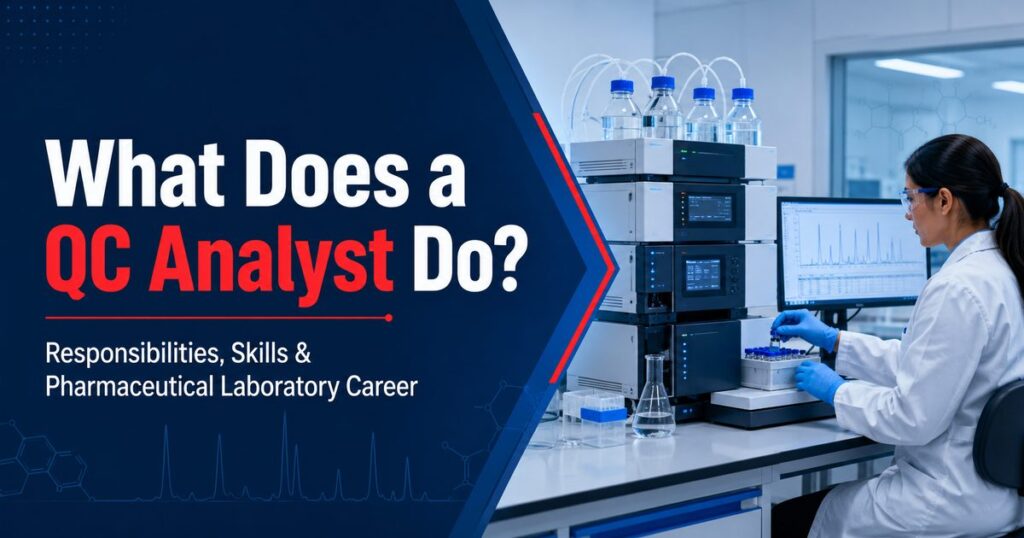
Learn what a QC analyst does in a pharmaceutical laboratory, including responsibilities, required skills, documentation duties, GMP expectations, and beginner career preparation.
Quality control analysts play a critical role in pharmaceutical laboratories. Their work helps confirm that raw materials, intermediate products, and finished medicines meet established quality specifications before they are released for use.
The role involves much more than operating laboratory instruments. A QC analyst must prepare samples correctly, follow approved analytical procedures, document every step accurately, review results carefully, and respond appropriately when unexpected findings occur.
This article explains the main responsibilities of a pharmaceutical QC analyst, the techniques commonly used in the laboratory, and the practical skills needed to succeed in this career.
What Is a QC Analyst?
A quality control analyst is a laboratory professional responsible for testing materials and products against approved specifications. In a pharmaceutical company, the analyst helps verify the identity, strength, purity, quality, and consistency of materials used during manufacturing.
QC analysts normally work according to approved methods, standard operating procedures, pharmacopoeial requirements, and Good Manufacturing Practice principles. Their results become part of the official quality record used to decide whether a material or product can be accepted, rejected, or investigated further.
Main Responsibilities of a QC Analyst
A pharmaceutical QC analyst performs several connected responsibilities. The exact duties may vary between laboratories, but the main objective remains the same: to generate reliable analytical results and document them correctly.
1. Testing Raw Materials and Finished Products
QC analysts test raw materials, packaging materials, intermediate products, and finished pharmaceutical products according to approved specifications. Testing may include identification, assay, purity, dissolution, moisture content, pH, and other quality attributes.
2. Preparing Samples and Standards
Accurate sample preparation is essential for reliable results. The analyst may weigh materials, prepare dilutions, filter solutions, prepare reference standards, and ensure that all calculations and preparation steps are documented correctly.
3. Performing Instrumental Analysis
QC laboratories use several analytical instruments and techniques. Depending on the product and laboratory, analysts may work with HPLC, UV-Visible spectroscopy, dissolution testers, pH meters, balances, and other analytical equipment.
The analyst must follow the approved method, verify that the system is suitable for analysis, and monitor the run for unexpected results or instrument-related problems.
4. Reviewing and Documenting Results
Analytical results must be recorded clearly, accurately, and at the time the work is performed. QC analysts review chromatograms, calculations, instrument outputs, worksheets, and laboratory records before submitting the analysis for further review.
Good documentation is not an administrative task added after testing. It is an essential part of the analytical work itself.
5. Responding to Unexpected Results
When a result falls outside the approved specification or appears unusual, the analyst should not simply repeat the test without justification. The result must be reported and evaluated according to the laboratory procedure.
The analyst may help review sample preparation, calculations, instrument performance, standards, reagents, chromatograms, and any changes that occurred during the analysis.
6. Maintaining Laboratory Readiness
QC analysts also help keep the laboratory ready for reliable testing. This may include checking instrument status, preparing reagents, monitoring solution expiry dates, reviewing logbooks, handling reference standards correctly, and reporting equipment problems when they occur.
Instruments and Techniques Used in Pharmaceutical QC
Pharmaceutical QC laboratories use a combination of instrumental and conventional analytical techniques. The specific equipment used depends on the type of product, the approved analytical method, and the quality attribute being evaluated.
Common instruments and techniques may include:
- High-Performance Liquid Chromatography (HPLC): Used for assay determination, impurity testing, content uniformity, and other quantitative analyses.
- UV-Visible Spectrophotometry: Used for identification and quantitative measurements when the analyte absorbs ultraviolet or visible light.
- Dissolution Testing: Used to evaluate how quickly and consistently an active ingredient is released from tablets or capsules.
- pH Measurement: Used to confirm the acidity or alkalinity of solutions and pharmaceutical preparations.
- Analytical Balances: Used for accurate weighing of samples, standards, and reagents.
- Moisture Analysis: Used to evaluate water content or loss on drying when required by the specification.
- Physical Testing: May include appearance, hardness, friability, viscosity, density, and other product-specific tests.
Operating an instrument is only one part of the analyst’s responsibility. The analyst must also understand the approved procedure, confirm that the equipment is ready for use, prepare samples and standards correctly, and evaluate whether the generated results are scientifically reasonable.
Documentation and GMP Responsibilities
Pharmaceutical laboratory work must be performed and documented according to Good Manufacturing Practice requirements. Every recorded result should be clear, accurate, traceable, and supported by the original analytical data.
A QC analyst is normally expected to:
- Record activities at the time they are performed.
- Use approved worksheets, methods, and standard operating procedures.
- Document calculations and sample preparation steps clearly.
- Avoid undocumented changes or corrections.
- Maintain traceability for samples, standards, reagents, and instruments.
- Report errors, deviations, and unexpected observations promptly.
- Ensure that electronic and paper records remain complete and reviewable.
Good documentation protects both the product and the analyst. Even a scientifically correct result may become unacceptable when the supporting records are incomplete, unclear, or inconsistent.
Skills Required for a Successful QC Analyst
Technical knowledge is important, but successful QC work also depends on discipline, accuracy, communication, and scientific judgment.
Important skills include:
- Attention to detail: Small weighing, dilution, calculation, or documentation errors can affect the final result.
- Understanding analytical procedures: The analyst should understand the purpose and sequence of each method step rather than following instructions mechanically.
- Basic troubleshooting ability: Analysts should recognize unusual chromatograms, instrument warnings, preparation errors, and inconsistent results.
- Accurate documentation: Every activity, observation, and result must be recorded clearly and at the correct time.
- Time management: QC laboratories often handle several samples, instruments, and deadlines simultaneously.
- Communication skills: Unexpected results, deviations, and equipment problems must be reported clearly to supervisors and reviewers.
- Scientific judgment: Analysts should evaluate whether results are reasonable and identify when further review is required.
- Commitment to procedure: Approved methods and laboratory procedures must be followed consistently.
For beginners, technical confidence develops gradually through training and practical experience. The strongest foundation is built by understanding laboratory principles, asking appropriate questions, and learning from each analytical run.
QC Analyst vs R&D Analyst
Quality control and research and development analysts may use similar instruments, but their objectives are different.
A QC analyst normally works with approved methods and established specifications. The primary goal is to determine whether materials and products meet predefined quality requirements.
An R&D analyst is more likely to develop, modify, optimize, or validate analytical methods. The work may involve testing different chromatographic conditions, investigating separation behavior, and supporting the development of new products or analytical procedures.
QC work generally emphasizes consistency, compliance, documentation, and routine execution. R&D work usually requires more experimentation, method development, and scientific flexibility.
Both roles require strong analytical skills, but beginners should understand which working environment better matches their interests and career goals.
How Beginners Can Prepare for a QC Analyst Career
Starting a career in pharmaceutical quality control requires more than memorizing instrument names or analytical definitions. Employers normally look for candidates who understand the laboratory environment, follow procedures carefully, and communicate clearly.
Beginners can prepare by focusing on the following areas:
- Build a strong analytical chemistry foundation: Review concentration calculations, dilutions, solution preparation, calibration concepts, and basic data interpretation.
- Understand HPLC fundamentals: Learn the purpose of the main system components, how a chromatogram is generated, and how common problems affect analytical results.
- Study GMP and data integrity principles: Understand why documentation, traceability, approved procedures, and contemporaneous recording are essential.
- Practice laboratory calculations: Become comfortable with percentages, dilution factors, standard preparation, assay calculations, and unit conversions.
- Learn basic troubleshooting logic: Practice identifying whether a problem may be related to the sample, standard, mobile phase, column, instrument, or calculation.
- Prepare for technical interviews: Be ready to explain common laboratory procedures, HPLC principles, documentation expectations, and how you would respond to an unexpected result.
- Develop professional communication skills: Analysts must describe observations clearly, ask appropriate questions, and report problems without hiding or minimizing them.
Fresh graduates are not expected to know every laboratory procedure immediately. However, they should demonstrate careful thinking, willingness to learn, respect for procedures, and a clear understanding of why pharmaceutical quality control is important.
New to HPLC?
Download the Free HPLC Starter Kit for a clear, practical, and beginner-friendly introduction to HPLC fundamentals, system components, common mistakes, and basic troubleshooting.
Conclusion
A pharmaceutical QC analyst plays an essential role in confirming that materials and finished products meet approved quality requirements. The work combines laboratory testing, accurate sample preparation, instrument operation, documentation, result evaluation, and compliance with established procedures.
Success in QC does not depend only on knowing how to operate analytical instruments. It also requires attention to detail, scientific judgment, reliable documentation, clear communication, and the discipline to investigate unexpected results correctly.
For students and fresh graduates, building a strong foundation in analytical chemistry, GMP principles, laboratory calculations, and practical HPLC concepts can make the transition into a pharmaceutical laboratory much easier.
Ready to Build Practical HPLC Skills?
Continue your learning with the Complete 17-Part HPLC Practical Guide Series. Explore HPLC fundamentals, system components, practical analysis, troubleshooting, method development, QC readiness, career preparation, and realistic laboratory cases.