The HPLC column is one of the most important parts of the HPLC system.
For many beginners, the column looks like a simple metal tube connected between the injector and the detector. But in reality, the column is where the actual separation happens.
The pump moves the mobile phase through the system.
The injector introduces the sample.
The detector records the response.
But the column is responsible for separating the components of the sample before they reach the detector.
If the column is not suitable, not equilibrated, contaminated, damaged, or used incorrectly, the chromatogram can show many problems, such as poor peak shape, shifting retention time, high pressure, low resolution, or unexpected peaks.
This article gives a beginner-friendly overview of what an HPLC column does, how column selection is usually understood, and what common problems analysts may see during routine HPLC work.
What Is an HPLC Column?
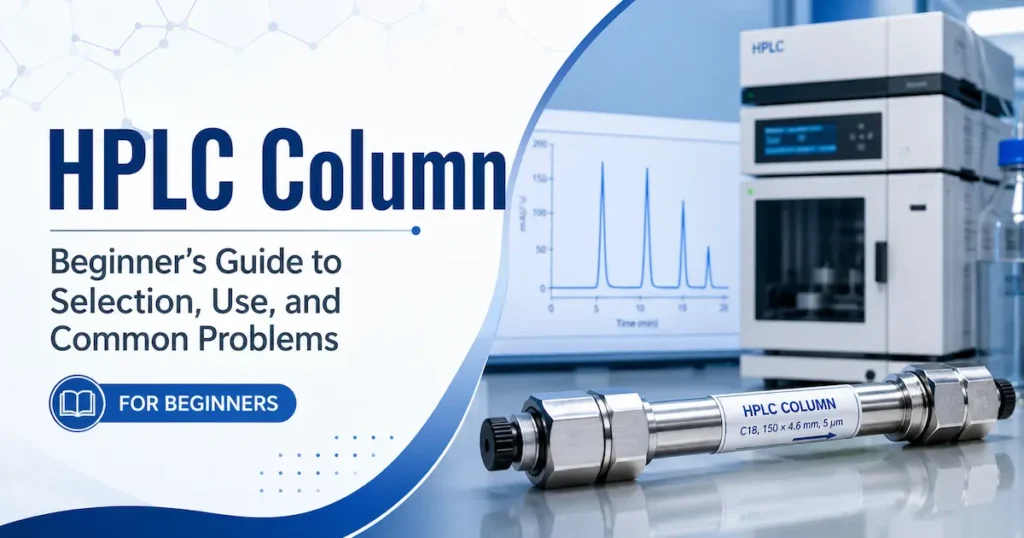
An HPLC column is a tube packed with small particles called the stationary phase.
When the sample enters the column, different compounds interact with the stationary phase and the mobile phase in different ways. Some compounds move faster through the column, while others are retained longer.
This difference in movement allows the compounds to separate from each other.
In simple terms:
The HPLC column controls how well the sample components are separated.
This is why the column has a direct effect on:
- Retention time
- Peak shape
- Resolution
- Pressure
- Sensitivity
- Reproducibility
- System suitability results
A good method depends heavily on using the correct column under the correct conditions.
Why the Column Is So Important in HPLC
When beginners see a problem in an HPLC chromatogram, they may immediately think the instrument is faulty. But many chromatographic problems are related to the column or to how the column is being used.
For example:
If the pressure is high, the column may be blocked or contaminated.
If the retention time changes, the column may not be equilibrated properly.
If the peak is tailing, the column chemistry, sample interaction, or contamination may be involved.
If the resolution is poor, the column may not be suitable for the separation.
This does not mean every HPLC problem comes from the column. But the column should always be part of the investigation.
A beginner should learn to ask:
Is the column suitable, clean, equilibrated, and used under the correct method conditions?
Common HPLC Column Terms Beginners Should Know
Before discussing column selection, it is helpful to understand some common terms.
Column Length
Column length affects separation and analysis time.
A longer column may give better separation, but it can also increase run time and pressure.
A shorter column may give faster analysis, but sometimes with less separation.
Internal Diameter
The internal diameter affects flow rate, sensitivity, and solvent consumption.
Many routine analytical HPLC methods use columns with internal diameters such as 4.6 mm or 3.0 mm, depending on the method and system.
Particle Size
The stationary phase is made of small particles.
Smaller particles can improve efficiency and peak shape, but they usually increase system pressure.
This is why the column particle size must be suitable for the HPLC system being used.
Stationary Phase
The stationary phase is the material inside the column that interacts with the sample.
The most common reversed-phase HPLC column is the C18 column.
Other examples include C8, phenyl, cyano, amino, and different specialized phases.
C18 Column: Why Beginners See It So Often
Many beginners first hear about the C18 column because it is one of the most widely used column types in reversed-phase HPLC.
A C18 column contains long hydrocarbon chains bonded to the silica surface. It is commonly used for the separation of many pharmaceutical compounds, impurities, and related substances.
In reversed-phase HPLC, the mobile phase is usually more polar than the stationary phase. Compounds are separated based on how strongly they interact with the stationary phase and the mobile phase.
A simple way to think about it:
Compounds that interact more strongly with the C18 stationary phase usually stay longer in the column.
Compounds that interact less strongly usually elute earlier.
This is a simplified explanation, but it helps beginners understand why column chemistry affects retention time and separation.
How Column Selection Affects the Chromatogram
Column selection can change the entire chromatogram.
A different column may change:
- Which peak comes first
- How far peaks are separated
- Whether peaks are sharp or broad
- Whether peaks tail
- The total run time
- The pressure of the method
This is why analysts should not randomly change columns without understanding the method requirements.
Even two C18 columns from different brands may not behave exactly the same. Differences in particle technology, surface chemistry, pore size, carbon load, and endcapping can affect chromatographic behavior.
For beginners, the key lesson is:
The column is not just a replaceable tube. It is part of the method.
Changing the column can change the result.
Basic Column Selection Factors
In routine work, the analyst usually follows the approved method. The column type, dimensions, particle size, and operating conditions should already be defined.
However, beginners should understand the basic factors behind column selection.
| Factor | Why It Matters |
|---|---|
| Stationary phase | Controls interaction with analytes |
| Column length | Affects separation and run time |
| Particle size | Affects efficiency and pressure |
| Internal diameter | Affects flow rate and sensitivity |
| pH range | Protects column stability |
| Temperature limit | Prevents column damage |
| Mobile phase compatibility | Avoids poor performance or column damage |
This does not mean a beginner should change method conditions without approval. In regulated pharmaceutical laboratories, method conditions must be followed carefully.
But understanding these factors helps analysts troubleshoot problems more logically.
Common HPLC Column Problems
Many HPLC problems may involve the column directly or indirectly.
Here are some common column-related issues beginners should recognize.
1. High Back Pressure
High pressure may happen when the column becomes blocked or contaminated.
Possible causes include:
- Particles from the sample
- Poorly filtered mobile phase
- Precipitation inside the column
- Strongly retained sample components
- Blocked inlet frit
Before blaming the pump, the analyst should check whether the pressure increase is related to the column, guard column, mobile phase, or system blockage.
2. Poor Peak Shape
Poor peak shape can appear as tailing, fronting, broad peaks, or split peaks.
Column-related causes may include:
- Column contamination
- Strong interaction between analyte and stationary phase
- Wrong column chemistry
- Column overload
- Column aging
- Poor equilibration
Peak shape problems should not be ignored because they may affect integration, accuracy, and system suitability.
3. Retention Time Shift
Retention time shift means the peak appears earlier or later than expected.
Column-related causes may include:
- Insufficient column equilibration
- Column aging
- Change in column temperature
- Change in mobile phase composition
- Different column batch or brand
- Contamination affecting stationary phase behavior
Retention time shift is often not caused by one factor only. The mobile phase, column, flow rate, temperature, and system condition should all be considered.
4. Loss of Resolution
Resolution means how well two peaks are separated.
Poor resolution may happen when the column no longer provides the same separation as before.
Possible reasons include:
- Column deterioration
- Wrong column type
- Insufficient equilibration
- Mobile phase preparation error
- Temperature variation
- Method not suitable for the sample
In pharmaceutical analysis, poor resolution can be a serious issue, especially when separating impurities from the main peak.
5. Extra or Ghost Peaks
Extra peaks may sometimes be related to column contamination or carryover.
They can also come from the mobile phase, sample diluent, blank, previous injections, or system contamination.
A beginner should not assume every extra peak is from the sample. Blank injections and system checks are often useful in identifying the source.
Practical Column Care Tips for Beginners
Good column care helps maintain method performance and reduce unnecessary problems.
Here are some basic practices beginners should follow:
- Always use the column according to the method
- Filter samples when required
- Use clean and properly prepared mobile phase
- Avoid sudden pressure shocks
- Do not exceed the column pressure limit
- Do not exceed the recommended pH range
- Use the correct storage solvent
- Allow proper column equilibration before analysis
- Record column use and performance
- Use a guard column when required by the method
A column may look unchanged from the outside, but its internal performance can slowly change with use.
This is why column history is important.
What Is a Guard Column?
A guard column is a small protective column placed before the analytical column.
Its role is to protect the main column from contamination, particles, and strongly retained compounds.
A guard column is usually cheaper and easier to replace than the main analytical column.
In routine analysis, using a guard column can help extend the life of the analytical column, especially when samples are complex or not perfectly clean.
However, the guard column must be compatible with the analytical column and method.
Common Beginner Mistakes with HPLC Columns
Beginners often make simple mistakes that can affect column performance.
Some common examples include:
- Installing the column in the wrong flow direction
- Not allowing enough equilibration time
- Using the wrong mobile phase
- Storing the column in an unsuitable solvent
- Injecting dirty samples
- Ignoring pressure changes
- Changing the column without documenting it
- Using a different column brand without checking method requirements
- Assuming every chromatogram problem means the column is damaged
A column should not be replaced too quickly without checking other possible causes.
At the same time, a column should not be kept in use when it clearly fails to meet method requirements.
The analyst needs balance: check logically, document properly, and follow the laboratory procedure.
How to Think Like an Analyst
When reviewing a chromatogram, do not look only at the final result.
Ask yourself:
- Is the retention time stable?
- Are the peaks sharp and symmetrical?
- Is the pressure normal?
- Is the baseline acceptable?
- Are there any extra peaks?
- Is the resolution acceptable?
- Did the system suitability pass?
- Was the column equilibrated properly?
- Is this the correct column for the method?
These questions help beginners move from simply operating the instrument to understanding the analysis.
The goal is not only to run HPLC.
The goal is to understand what the chromatogram is telling you.
When Should You Suspect a Column Problem?
You may suspect a column-related issue when you see repeated problems such as:
- Gradual pressure increase
- Repeated peak tailing
- Loss of resolution
- Retention time instability
- Broad peaks
- Poor system suitability results
- Problems continuing after fresh mobile phase preparation
- Problems appearing after many injections on the same column
However, column problems should be confirmed carefully.
In HPLC troubleshooting, it is better to test step by step rather than guess.
Final Thoughts
The HPLC column is one of the most important parts of the chromatographic system.
It controls separation, affects peak shape, influences retention time, and plays a major role in system suitability.
For beginners, understanding the column is a major step toward understanding HPLC.
You do not need to know every advanced detail at the beginning. But you should understand the basic role of the column, why column selection matters, and how column-related problems can appear in routine analysis.
A strong HPLC analyst does not only look at the result.
A strong analyst looks at the whole chromatogram and thinks about the method, mobile phase, column, system condition, and sample behavior together.
New to HPLC? Start with the Free Starter Kit
Download a practical beginner-friendly PDF guide to help you understand common HPLC problems and what to check first.
Ready to Go Beyond the Basics?
Continue your learning with the complete 17-part HPLC Practical Guide series designed for beginners, junior analysts, fresh graduates, and QC laboratory starters. Build practical confidence in HPLC fundamentals, system components, troubleshooting, QC readiness, and realistic laboratory cases.