
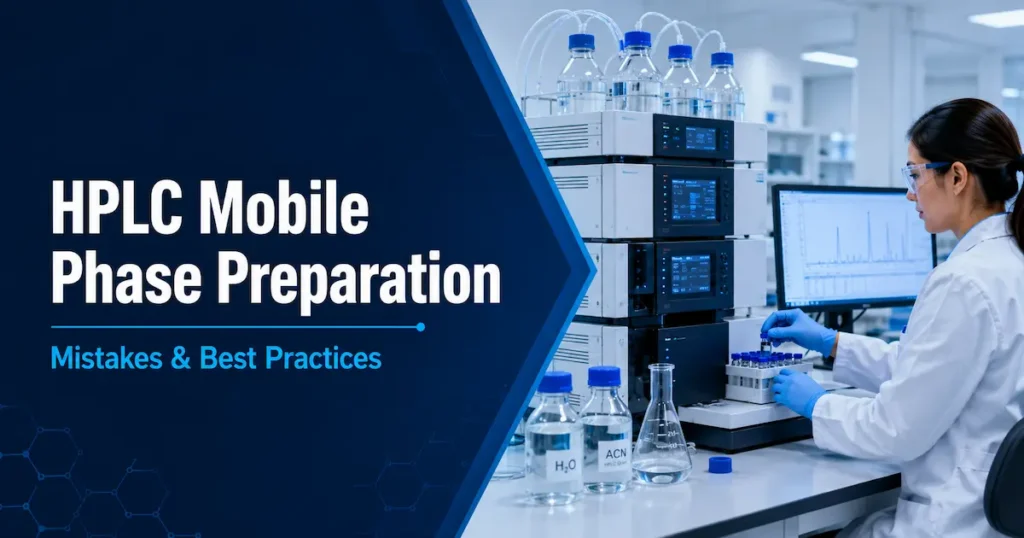
Learn how to prepare an HPLC mobile phase correctly, avoid common preparation mistakes, and improve the consistency of chromatographic results.
Mobile phase preparation is one of the most important routine tasks in high-performance liquid chromatography. Even when the instrument, column, and analytical method are suitable, an incorrectly prepared mobile phase can produce unstable pressure, shifting retention times, noisy baselines, distorted peaks, and poor reproducibility.
Many mobile phase problems are caused by simple preparation errors rather than instrument failure. Using unsuitable solvents, measuring components inaccurately, adjusting pH incorrectly, or failing to mix and degas the solution properly can affect the entire chromatographic run.
This article explains the basic principles of HPLC mobile phase preparation, the most common beginner mistakes, and the best practices that help produce reliable and repeatable results.
Why Is Mobile Phase Preparation Important?
The mobile phase carries the sample through the HPLC system and interacts with both the analytes and the stationary phase inside the column. Its composition directly influences retention, selectivity, peak shape, system pressure, and detector response.
Small differences in solvent ratio, pH, buffer concentration, or preparation technique can lead to noticeable differences in chromatographic results.
Correct mobile phase preparation helps achieve:
- Stable retention times.
- Consistent system pressure.
- Good peak shape.
- Reproducible peak areas.
- A stable detector baseline.
- Reliable system suitability results.
- Better agreement between analysts and laboratories.
For regulated pharmaceutical testing, the mobile phase must always be prepared according to the approved analytical method or standard operating procedure.
Main Components of an HPLC Mobile Phase
An HPLC mobile phase may contain water, one or more organic solvents, buffers, acids, bases, or other additives. The exact composition depends on the analytical method and the chemical properties of the compounds being tested.
Water
Water used for HPLC should have suitable purity. Laboratory tap water is not acceptable because it may contain dissolved salts, particles, microorganisms, and organic contaminants.
Purified water should be obtained from a properly maintained laboratory water system and should meet the requirements of the analytical procedure.
Poor-quality water may cause:
- Baseline noise or drifting.
- Unexpected detector peaks.
- Increased column pressure.
- Contamination of the HPLC system.
- Shorter column lifetime.
Water quality is especially important when using UV detection at low wavelengths.
Organic Solvents
Common organic solvents used in reversed-phase HPLC include methanol and acetonitrile. Other solvents may be used when specified by the method.
Only solvents of a grade suitable for HPLC should be used. Lower-grade solvents may contain impurities that absorb ultraviolet light or contaminate the system.
Solvent bottles should remain tightly closed when not in use because some solvents can absorb moisture from the air or evaporate, changing their composition.
Buffers and Additives
Buffers are used to control mobile phase pH and improve chromatographic reproducibility. Common buffer components include phosphate, acetate, and formate salts.
Acids or bases may also be added to control pH or improve peak shape. Examples include phosphoric acid, acetic acid, formic acid, and ammonium hydroxide.
The selected buffer must be:
- Compatible with the analytical method.
- Soluble in the final mobile phase composition.
- Suitable for the detector.
- Prepared at the specified concentration.
- Compatible with the HPLC column and system.
When mass spectrometry is used, volatile buffers and additives are generally required.
Common Mobile Phase Preparation Mistakes
1. Using the Wrong Solvent Grade
Using general laboratory-grade solvents instead of HPLC-grade solvents may introduce contaminants into the system.
These impurities can create ghost peaks, baseline noise, detector contamination, or gradual column damage.
Always verify the solvent label before use and ensure that the solvent is suitable for the analytical technique.
2. Measuring Solvent Volumes Inaccurately
Incorrect solvent ratios are a common cause of retention-time changes.
For example, a small increase in the proportion of organic solvent in reversed-phase HPLC may cause compounds to elute earlier. A lower organic proportion may increase retention and extend the run time.
Use suitable volumetric glassware or calibrated measuring equipment. Do not estimate volumes using unmarked bottles or beakers when accurate composition is required.
3. Adjusting the pH at the Wrong Stage
The order of preparation can affect the final mobile phase pH.
In many methods, the aqueous buffer is prepared and its pH is adjusted before the organic solvent is added. However, the analyst must follow the exact procedure described in the approved method.
Measuring pH after adding a large proportion of organic solvent may produce unstable or method-dependent readings. The response of a standard pH electrode can change in mixed aqueous-organic solutions.
Do not change the specified preparation sequence unless the method has been formally evaluated and approved.
4. Using an Uncalibrated pH Meter
An inaccurate pH meter can cause an incorrectly adjusted mobile phase, even when the analyst follows the method carefully.
Before measuring pH:
- Confirm that the electrode is clean and suitable for use.
- Calibrate the pH meter with appropriate buffer solutions.
- Check that the calibration is acceptable.
- Rinse the electrode between measurements.
- Allow the reading to stabilize before adjustment.
Add acid or base gradually, especially when the target pH is close.
5. Adding Too Much Acid or Base
Adding a large amount of acid or base at once may cause the pH to move beyond the required value.
Repeatedly correcting an overadjusted solution can change the ionic strength and final composition of the mobile phase.
The safer approach is to add the adjusting solution slowly while stirring continuously. As the target pH is approached, use smaller additions.
6. Incomplete Dissolution of Buffer Salts
Undissolved salts may block filters, inlet frits, tubing, or the column.
Buffer components should be completely dissolved before the solution is transferred to the mobile phase reservoir. The solution should be visually inspected for particles or crystals.
The analyst should also confirm that the buffer remains soluble after the organic solvent is added. Some salts may precipitate when exposed to high concentrations of organic solvent.
7. Incorrect Mixing Order
The preparation order should follow the analytical method.
A typical procedure may involve preparing the aqueous buffer, adjusting its pH, and then combining it with the organic solvent. Other methods may specify a different order.
Changing the mixing sequence can affect pH, buffer solubility, and final composition.
8. Failing to Mix the Mobile Phase Thoroughly
A mobile phase may appear uniform even when it has not been mixed sufficiently.
After all components have been added, the solution should be mixed thoroughly using a suitable technique. Poor mixing may cause gradual changes in retention time as the HPLC system draws mobile phase from different parts of the reservoir.
9. Ignoring Filtration Requirements
Buffered or particle-containing mobile phases may require filtration using a compatible membrane filter.
Filtration can remove particulate matter that might block the HPLC system or increase column pressure. However, the filter material must be chemically compatible with the mobile phase.
The analytical procedure or laboratory SOP should specify whether filtration is required and which membrane type and pore size should be used.
10. Inadequate Degassing
Dissolved gases may form bubbles inside the HPLC system. These bubbles can disturb pump operation, cause pressure fluctuations, or create detector noise.
Common degassing approaches include:
- Online vacuum degassing.
- Sonication.
- Vacuum filtration.
- Helium sparging when specified.
The most appropriate technique depends on the instrument and laboratory procedure.
Even when an online degasser is available, proper mobile phase preparation and secure solvent-line connections remain important.
11. Using Old or Contaminated Mobile Phase
Mobile phases should not be used indefinitely.
Aqueous and buffered solutions may support microbial growth or change during storage. Volatile components may also evaporate, changing the mobile phase composition.
The acceptable storage period should be defined by the analytical method, laboratory SOP, or stability assessment.
Never return unused mobile phase from the reservoir to the original solvent bottle.
12. Poor Labeling
An unlabeled or incorrectly labeled mobile phase creates a serious laboratory risk.
Each prepared mobile phase should normally be labeled with information such as:
- Mobile phase name or composition.
- Preparation date.
- Expiry or use-by date.
- Analyst initials or identification.
- Method or product reference when required.
- Storage conditions when applicable.
Clear labeling reduces mix-ups and improves traceability.
Best Practices for Reliable Mobile Phase Preparation
Follow the Approved Method Exactly
The analytical method should remain the primary source of instructions. Use the specified solvents, concentrations, pH, preparation order, filtration procedure, and storage conditions.
Do not make informal changes because a different preparation method appears easier.
Use Clean and Suitable Glassware
Mobile phase containers and volumetric glassware should be clean and free from detergent residues or previous chemicals.
Rinse equipment appropriately and inspect it before use. Contaminated glassware may introduce unexpected peaks or baseline disturbances.
Record Actual Quantities
Document the identity and amount of every component used.
Where required, record:
- Solvent and reagent names.
- Manufacturer and lot numbers.
- Actual weights and volumes.
- pH before and after adjustment.
- Preparation date and time.
- Analyst identification.
Good documentation allows the preparation to be reviewed and repeated.
Control Evaporation
Organic solvents may evaporate during preparation and use.
Keep bottles closed whenever possible and use suitable reservoir caps. Avoid leaving prepared mobile phase uncovered for extended periods.
Evaporation can increase the proportion of water and gradually change retention times.
Check Compatibility Before Mixing
Before combining a buffer with a high percentage of organic solvent, confirm that the buffer is sufficiently soluble.
If precipitation appears, do not place the mobile phase on the HPLC system. Investigate the composition and preparation procedure first.
Salt precipitation may block tubing, valves, frits, and columns.
Prepare an Appropriate Volume
Prepare enough mobile phase to complete the sequence, including system equilibration, injections, washing, and any expected repeat tests.
Running out of mobile phase during an analysis may allow air to enter the solvent line and pump.
At the same time, avoid preparing unnecessarily large quantities that may remain unused beyond the approved storage period.
A Simple Mobile Phase Preparation Workflow
A general preparation workflow may include the following steps:
- Review the analytical method and confirm the required composition.
- Check the identity, grade, and expiry of all solvents and reagents.
- Clean and inspect the required glassware and mobile phase bottle.
- Weigh buffer salts accurately when required.
- Dissolve the buffer completely in the specified amount of water.
- Calibrate the pH meter.
- Adjust the aqueous solution to the specified pH using the required reagent.
- Add the organic solvent according to the method.
- Mix the complete mobile phase thoroughly.
- Filter the solution when required.
- Degas the mobile phase using the approved procedure.
- Transfer it to a clean, labeled reservoir.
- Prime and purge the HPLC solvent lines before analysis.
- Equilibrate the system and column until stable conditions are obtained.
This workflow is only a general guide. The approved analytical method must always take priority.
Signs of a Possible Mobile Phase Problem
When chromatographic results change unexpectedly, the mobile phase should be included in the investigation.
Possible warning signs include:
- Retention times shifting between injections.
- Increasing or unstable system pressure.
- Poor peak symmetry.
- Loss of resolution.
- Baseline noise or drift.
- Unexpected peaks.
- Variable peak areas.
- Failure of system suitability tests.
Before assuming that the column or instrument is defective, check:
- Was the correct mobile phase prepared?
- Were all components measured accurately?
- Was the correct pH obtained?
- Was the solution mixed thoroughly?
- Is there visible contamination or precipitation?
- Was the mobile phase prepared recently?
- Are the solvent inlet filters fully immersed?
- Has air entered the solvent line?
Preparing a fresh mobile phase according to the approved method is often a useful troubleshooting step.
Final Takeaway
Reliable HPLC analysis begins with accurate mobile phase preparation.
A mobile phase that is prepared using suitable solvents, correct measurements, controlled pH, proper mixing, filtration when required, and effective degassing supports stable pressure, consistent retention times, and reproducible chromatographic results.
Most mobile phase problems can be prevented by following the approved method carefully, using clean equipment, documenting each preparation step, and avoiding unnecessary changes to the procedure.
For a beginner, the most important principle is simple: treat mobile phase preparation as a critical analytical operation, not as a routine mixing task.
New to HPLC?
Download the Free HPLC Starter Kit for a clear, practical, and beginner-friendly introduction to HPLC fundamentals, system components, common mistakes, and basic troubleshooting.
.
Ready to Build Practical HPLC Skills?
Continue your learning with the Complete 17-Part HPLC Practical Guide Series. Explore HPLC fundamentals, system components, practical analysis, troubleshooting, method development, QC readiness, career preparation, and realistic laboratory cases.