
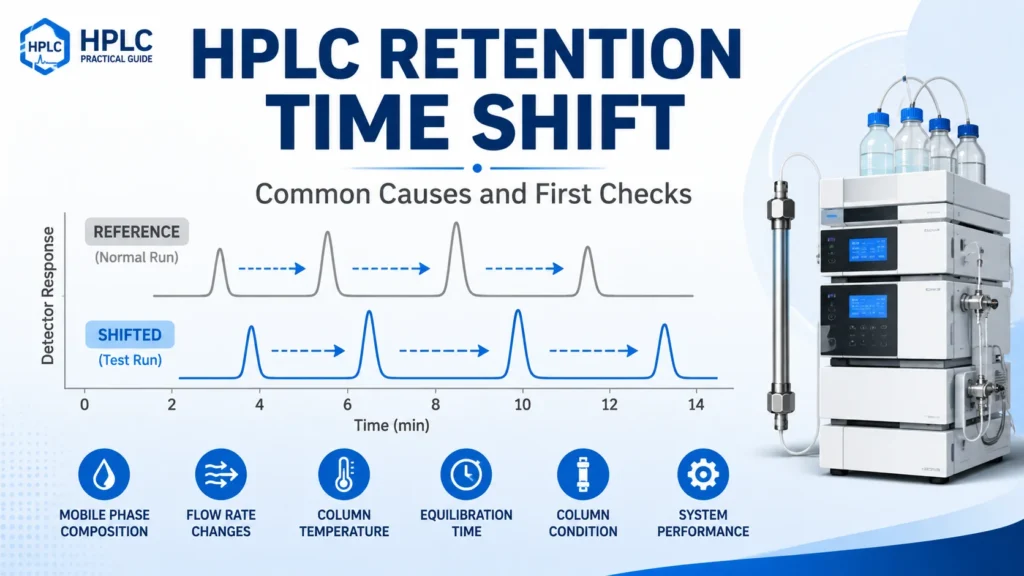
Retention time is one of the first values analysts compare when reviewing an HPLC chromatogram.
When the same compound appears at a different time than expected, it is usually described as a retention time shift.
For example, a peak that normally appears at 5.20 minutes may appear at 4.90 minutes or 5.60 minutes during another run.
A small difference may sometimes be normal. However, a clear or repeated shift may indicate a change in the HPLC conditions, mobile phase, flow rate, column, temperature, or system performance.
For many beginners, a retention time shift immediately creates concern that the column is damaged.
But the column is only one possible cause.
The correct first step is not to replace the column. The correct first step is to identify the pattern of the shift and check the simplest possible causes.
This article explains what an HPLC retention time shift means, the common causes, and the first checks a beginner should perform.
What Is Retention Time in HPLC?
Retention time is the time required for a compound to travel through the HPLC system and reach the detector after injection.
It is usually measured from the moment of injection until the maximum point of the chromatographic peak.
For example, if a compound is injected at the beginning of the run and its peak appears after 6.5 minutes, its retention time is approximately 6.5 minutes.
Retention time depends on several conditions, including:
- Mobile phase composition
- Flow rate
- Column chemistry
- Column temperature
- Analyte properties
- Method conditions
- System volume
Under consistent chromatographic conditions, the retention time of the same compound should remain reasonably consistent.
However, it may not always be exactly identical in every injection.
What Is an HPLC Retention Time Shift?
An HPLC retention time shift occurs when a peak appears earlier or later than its usual or expected position.
A peak may shift:
- To the left, meaning it appears earlier
- To the right, meaning it appears later
- Gradually over several injections
- Suddenly after a change in the method or system
- Randomly from one injection to another
There is no single universal retention time difference that is acceptable for every HPLC method.
The acceptable range depends on:
- The analytical method
- The system suitability requirements
- The laboratory procedure
- The type of analysis
- Whether the method is validated
The important question is whether the shift is within the method requirements and whether the system remains reproducible.
Are All Peaks Shifting or Only One Peak?
This is one of the most useful first questions during troubleshooting.
If All Peaks Shift in the Same Direction
When most or all peaks move earlier or later together, the cause is often related to a general system or method condition.
Possible causes include:
- Flow rate change
- Mobile phase composition change
- Temperature change
- Gradient timing difference
- Insufficient column equilibration
- Pump performance problem
For example, if all peaks appear later than usual, the actual flow rate may be lower or the mobile phase may be weaker than expected.
If Only One Peak Shifts
When one peak shifts while the other peaks remain stable, the cause may be more specific to that compound.
Possible causes include:
- Change in sample composition
- Sample degradation
- Incorrect peak identification
- Mobile phase pH change
- Column selectivity change
- Peak integration problem
- Interaction with another sample component
A single moving peak does not usually indicate a simple overall flow-rate problem.
Why Is Retention Time Important?
Retention time is often used as part of peak identification.
It also helps analysts evaluate whether the chromatographic system is operating consistently.
A retention time shift can affect:
- Peak identification
- System suitability
- Integration windows
- Resolution between peaks
- Reproducibility
- Method reliability
- Comparison with previous results
A large shift may also cause a peak to move close to another peak, which can reduce separation or create an integration problem.
This is why retention time changes should be investigated systematically.
New to HPLC? Start with the Free Starter Kit
Download a practical beginner-friendly PDF guide to help you understand common HPLC problems and what to check first.

Common Causes of HPLC Retention Time Shift
1. Flow Rate Changes
Flow rate has a direct effect on how quickly compounds travel through the column.
If the actual flow rate increases, peaks usually appear earlier.
If the actual flow rate decreases, peaks usually appear later.
Possible reasons include:
- Incorrect flow rate entered in the method
- Pump calibration problem
- Air inside the pump
- Pump check-valve problem
- Mobile phase leakage
- Incomplete pump priming
- Unstable solvent delivery
The flow rate displayed in the software may not always represent the actual flow passing through the column.
Pressure behavior can provide useful information.
If retention times are changing and the system pressure is also unstable, the pump, mobile phase delivery, or a leak should be checked.
2. Mobile Phase Composition Changes
A small difference in mobile phase composition can produce a noticeable retention time change.
For many reversed-phase HPLC methods, increasing the percentage of organic solvent causes compounds to elute earlier.
Reducing the percentage of organic solvent often causes compounds to elute later.
However, the exact effect depends on the method and the compounds being analyzed.
Mobile phase composition may change because of:
- Incorrect solvent ratio
- Incorrect measuring volume
- Wrong solvent selected
- Incomplete mixing
- Solvent evaporation
- Incorrect gradient program
- Preparation error
- Different solvent quality
For example, preparing 55% methanol instead of 50% methanol may cause several peaks to move earlier.
Even when the mobile phase bottles look correct, the actual composition should still be verified.
3. Mobile Phase pH or Buffer Changes
Mobile phase pH can strongly affect the retention of ionizable compounds.
A small pH difference may change the ionization of an analyte and therefore change its interaction with the stationary phase.
This can cause:
- Retention time changes
- Resolution changes
- Peak shape changes
- Selectivity changes
Possible pH-related causes include:
- Incorrect buffer preparation
- Wrong buffer concentration
- Incorrect pH adjustment
- Measuring pH before adding the organic solvent when the method requires another procedure
- Using a different acid or base
- Old or contaminated buffer
- Temperature differences during pH measurement
A pH change may affect some compounds more strongly than others.
Therefore, if one or two peaks shift while the remaining peaks stay stable, the mobile phase pH should be considered.
4. Column Temperature Changes
Column temperature affects mobile phase viscosity and analyte interaction with the stationary phase.
A temperature change may alter retention time, pressure, selectivity, and resolution.
Possible causes include:
- Column oven not turned on
- Incorrect temperature entered
- Insufficient time for the oven to stabilize
- Room temperature change
- Column compartment problem
- Method transferred between systems with different temperature control
The direction and size of the retention change can vary depending on the method.
The first check is to confirm that the actual column temperature matches the method.
5. Insufficient Column Equilibration
A column needs time to reach stable conditions after a mobile phase change, system start-up, or gradient run.
If the column is not properly equilibrated, retention times may change during the first few injections.
Common signs include:
- Retention time gradually moving from injection to injection
- Pressure gradually stabilizing
- Baseline changing at the beginning of the sequence
- Later injections becoming more reproducible
Equilibration time depends on:
- Column dimensions
- Flow rate
- Mobile phase
- Gradient conditions
- Column chemistry
- Previous solvent inside the column
Running only a small amount of mobile phase through the column may not be enough.
The analyst should follow the method or laboratory procedure and confirm that several column volumes have passed when appropriate.
6. Column Condition or Column Difference
The column can affect retention time, but it should not be blamed before other conditions are checked.
Column-related causes include:
- Using the wrong column
- Different column length
- Different internal diameter
- Different particle size
- Different stationary phase
- Different manufacturer
- Column aging
- Column contamination
- Loss of stationary phase performance
- Incorrect column installation
- Guard-column contamination
Two columns with the same general description may still show small selectivity or retention differences.
A new column may also require sufficient equilibration before stable results are obtained.
If a retention time shift started immediately after changing the column, verify the complete column specification, not only the brand name.
7. Air Bubbles, Pump Problems, or Leaks
Unstable solvent delivery can produce unstable retention times.
Air bubbles inside the pump may cause:
- Flow-rate fluctuation
- Pressure fluctuation
- Retention time variation
- Baseline disturbance
Leaks may occur at:
- Pump connections
- Injector connections
- Column fittings
- Detector connections
- Solvent lines
A leak before the column may reduce the actual amount of mobile phase reaching the column.
This can cause peaks to appear later than expected.
The system should be inspected for visible leakage, unusual pressure, air bubbles, and unstable pump operation.
8. Gradient Timing and Dwell Volume
Gradient methods are especially sensitive to system timing and internal system volume.
The mobile phase composition programmed in the software does not reach the column immediately.
It must first travel through:
- The mixing system
- Pump tubing
- Injector
- Connecting tubing
This creates a delay known as gradient delay or dwell volume.
If the method is transferred to another HPLC system with a different dwell volume, the peaks may appear earlier or later.
Gradient retention changes may also result from:
- Incorrect gradient table
- Wrong starting composition
- Incorrect hold time
- Pump mixing problem
- Different system configuration
- Inadequate re-equilibration
This is especially important when comparing results from two different instruments.
9. Sample and Injection Conditions
Sample preparation usually has less effect on the retention time of all peaks, but it may affect individual peaks.
Possible causes include:
- Sample dissolved in an unsuitable solvent
- Injection solvent stronger than the mobile phase
- High sample concentration
- Large injection volume
- Sample degradation
- Incorrect sample pH
- Matrix interference
- Incorrect peak identification
A strong injection solvent often affects early peaks and may also cause peak distortion.
If only the sample peak shifts while the standard remains stable, the sample preparation should be investigated.
10. Incorrect Method or Software Settings
Sometimes the chromatographic system is working correctly, but the wrong method has been selected.
Possible errors include:
- Wrong flow rate
- Wrong column temperature
- Wrong gradient program
- Wrong run time
- Incorrect solvent channels
- Incorrect mobile phase labels
- Old method version
- Modified method not saved correctly
- Incorrect injection sequence
Before changing any hardware, verify the method settings shown in the software.
A simple method-selection error can create a large retention time difference.
First Checks for an HPLC Retention Time Shift
When a retention time shift is observed, use a logical sequence.
1. Confirm That the Comparison Is Valid
Make sure you are comparing results obtained using:
- The same method
- The same compound
- The same column type
- The same flow rate
- The same mobile phase
- The same temperature
- Similar system conditions
Do not compare two chromatograms unless the analytical conditions are equivalent.
2. Check Whether All Peaks Shifted
Determine whether:
- All peaks shifted together
- Only one peak shifted
- The shift is gradual
- The shift is random
- The shift started after a specific change
This observation helps reduce the number of possible causes.
3. Verify the Method Settings
Check:
- Flow rate
- Mobile phase channels
- Gradient table
- Column temperature
- Injection volume
- Run time
- Method version
Do not assume that the correct method was loaded.
4. Review Pressure and Flow Behavior
Compare the current pressure with previous normal runs.
Ask:
- Is the pressure higher?
- Is the pressure lower?
- Is the pressure unstable?
- Did the pressure change at the same time as the retention time?
Pressure changes can help identify flow, blockage, leakage, viscosity, or mobile phase problems.
5. Check the Mobile Phase
Confirm:
- Correct solvents
- Correct solvent ratios
- Correct buffer concentration
- Correct pH
- Proper mixing
- Proper filtration and degassing
- No visible contamination
- No excessive evaporation
If the shift began after preparing a new mobile phase, preparation should be one of the first areas investigated.
6. Confirm the Column Temperature
Check that:
- The column oven is operating
- The correct temperature is entered
- The system has reached the set temperature
- The column has had enough time to stabilize
7. Allow Sufficient Equilibration
Continue pumping the correct mobile phase and monitor:
- Pressure
- Baseline
- Retention time
- Repeatability
Do not judge the system based only on the first injection after start-up or a major solvent change.
8. Reinject the Standard
A standard reinjection can help determine whether the problem is:
- System-related
- Sample-related
- Temporary
- Reproducible
If the standard remains stable but the sample changes, investigate the sample.
9. Check the Column and System History
Ask whether any of the following occurred:
- Column replacement
- Guard-column replacement
- System maintenance
- Pump maintenance
- Tubing replacement
- Method transfer
- Mobile phase change
- Long system shutdown
A recent change often provides the strongest clue.
10. Change One Variable at a Time
Do not change the mobile phase, column, flow rate, temperature, and sample preparation at the same time.
Changing multiple variables may temporarily solve the problem, but it prevents identification of the real cause.
A good analyst changes one factor, observes the result, and documents the finding.
Quick Troubleshooting Table
| Observation | Possible Cause | First Check |
|---|---|---|
| All peaks appear earlier | Flow too high or mobile phase too strong | Verify flow rate and solvent composition |
| All peaks appear later | Flow too low or mobile phase too weak | Check pump delivery and mobile phase ratio |
| Retention time changes between injections | Air, pump instability, leak, or poor equilibration | Review pressure and prime the pump |
| Shift began after fresh mobile phase | Preparation, ratio, buffer, or pH error | Recheck mobile phase preparation |
| Shift began after changing the column | Different column or insufficient equilibration | Confirm column specification and equilibrate |
| Only one peak shifts | Sample, pH, selectivity, or peak identification | Compare standard and sample chromatograms |
| Gradient peaks shift on another instrument | Different dwell volume | Compare system configuration and gradient delay |
| Retention gradually stabilizes | Insufficient equilibration | Continue equilibration and repeat injections |
Common Beginner Mistakes
A common mistake is replacing the column immediately.
Other mistakes include:
- Changing several conditions at once
- Ignoring pressure changes
- Using old mobile phase without checking it
- Comparing runs from different methods
- Assuming the displayed flow rate is always correct
- Ignoring column temperature
- Running samples before equilibration is complete
- Failing to document when the shift started
The troubleshooting process becomes much easier when the analyst knows exactly what changed before the problem appeared.
A Practical Troubleshooting Example
Imagine that all peaks normally appear at:
- 3.2 minutes
- 5.8 minutes
- 8.4 minutes
After preparing a new mobile phase, the peaks appear at:
- 3.6 minutes
- 6.5 minutes
- 9.4 minutes
All peaks have moved later.
The pressure is similar to previous runs and remains stable.
In this situation, the analyst should not immediately replace the column.
The first checks should include:
- Mobile phase ratio
- Solvent identity
- Buffer concentration
- Mobile phase pH
- Mixing procedure
The mobile phase may be weaker than the original mobile phase.
If the correct mobile phase is prepared and the peaks return to their normal positions, the column was not the cause.
When Should the Problem Be Investigated Further?
Further investigation is needed when:
- Retention time repeatedly fails the method requirement
- System suitability fails
- Retention time is not reproducible
- Pressure is abnormal or unstable
- Resolution between peaks decreases
- Peak identification becomes uncertain
- A leak or pump problem is suspected
- A validated method no longer performs consistently
The method, instrument logbook, system suitability results, and previous chromatograms should be reviewed before making a major change.
Key Lesson
An HPLC retention time shift is a symptom, not a diagnosis.
The shift may result from:
- Flow rate
- Mobile phase
- pH
- Temperature
- Equilibration
- Column condition
- Pump performance
- Gradient timing
- Sample preparation
- Method settings
Start by determining whether all peaks shifted or only one peak.
Then check the simplest and most recent changes first.
A systematic investigation is usually more effective than immediately replacing the column or changing the method.
Frequently Asked Questions
What causes retention time to shift in HPLC?
Retention time may shift because of changes in flow rate, mobile phase composition, pH, column temperature, system equilibration, column condition, pump performance, or gradient timing.
Can the mobile phase cause a retention time shift?
Yes. Even a small change in solvent ratio, buffer concentration, or pH can change retention time, especially for ionizable compounds.
Does a retention time shift mean the HPLC column is damaged?
Not necessarily. The column is only one possible cause. Flow rate, mobile phase, temperature, equilibration, and method settings should be checked first.
How much retention time variation is acceptable?
There is no universal acceptable value for every method. The analyst should follow the system suitability requirements, validated method, or laboratory procedure.
Ready to Go Beyond the Basics?
Continue your learning with the complete 17-part HPLC Practical Guide series designed for beginners, junior analysts, fresh graduates, and QC laboratory starters. Build practical confidence in HPLC fundamentals, system components, troubleshooting, QC readiness, and realistic laboratory cases.